Medical gas pendants support anesthesia, ventilation, monitoring, and surgical equipment above the patient zone. They also carry oxygen, medical air, vacuum, electrical power, data connections, and sometimes scavenging lines. A loose arm, crossed hose, or damaged outlet can create serious clinical risks. So, what are the safety standards for medical gas pendants? The answer depends on the country, facility type, and pendant configuration. However, recognized requirements commonly address mechanical strength, gas identification, electrical safety, grounding, infection control, and emergency isolation.
Standards such as ISO 11197 and IEC 60601-1 may guide pendant construction and medical electrical safety. NFPA 99 can apply in the United States, while EN 7396-1 supports medical gas pipeline safety in many European settings. Local rules may add further requirements. Qualified engineers should verify outlet-specific connectors, pressure ratings, flow direction, alarm systems, and separation between gas and electrical services. The pendant should move smoothly, hold its position, and withstand expected loads without drifting over a patient.
Testing matters. Technicians should inspect pipe joints, labels, brakes, earth continuity, leakage, and gas identity before clinical use. They should also repeat checks after maintenance or relocation. A checklist helps, but it is not enough. A standard can be met on paper while poor installation practice remains unnoticed. Real safety depends on competent design, documented commissioning, staff training, and regular inspection. Even small details matter, such as a clear oxygen label or a brake that locks firmly beside the operating table. Local authorities and facility policies should always be consulted before final approval.
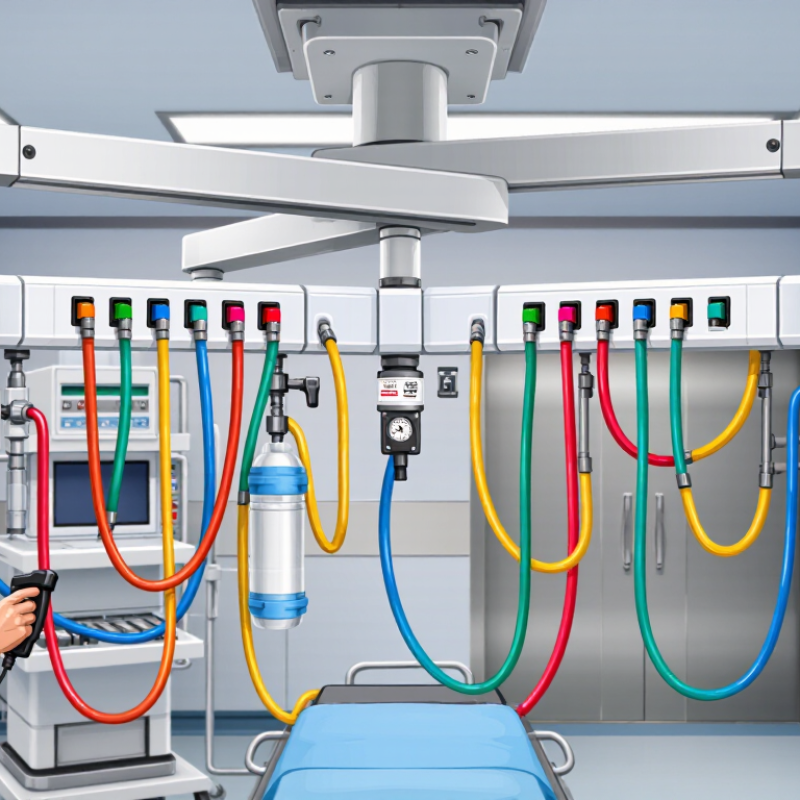
Medical gas pendant safety is defined by more than a strong arm or tidy appearance. ISO 11197 addresses the safety of medical supply units, including construction, electrical protection, mechanical stability, and essential performance. NFPA 99 adds practical requirements for healthcare facilities, such as medical gas piping, electrical systems, grounding, and clearance around patient-care equipment. Together, they create a framework for reducing fire, pressure, contamination, and collision risks.
A compliant pendant should remain stable during movement and under its rated load. Gas outlets must be clearly identified, securely connected, and tested for leaks. Electrical sockets need suitable grounding and protection against overloads. Installation teams should verify support structures, brake functions, hose routing, and emergency access. Testing should follow documented procedures, not visual inspection alone. In practice, small details matter: a stretched hose, a loose cover, or an unreadable label can become a serious hazard.
Tips: Check the adopted editions of ISO 11197 and NFPA 99. Local rules may add requirements. Request installation records, pressure-test results, electrical verification, and maintenance logs. Train staff to avoid pulling the pendant by hoses or cables. Keep its movement path clear. I have seen safety reviews focus heavily on gas pressure while overlooking collision zones. That gap deserves honest review. Standards guide the process, but competent inspection and repeated staff training determine whether protection works every day.
| Safety Dimension | ISO 11197 Perspective | NFPA 99 Perspective | Practical Verification Evidence |
|---|---|---|---|
| Primary scope | Specifies safety and essential-performance requirements for medical supply units, including equipment intended to distribute medical gases, vacuum, electrical power, and related services. | Provides installation, operation, maintenance, and testing requirements for health care facilities, including medical gas and vacuum systems and associated electrical and mechanical risks. | Approved design documents identify the pendant as a medical supply unit and show how product, installation, and facility requirements are addressed together. |
| Gas-service identification | Gas connections and outlets must be identifiable and arranged to prevent incorrect connection or interchange between different medical gases. | Medical gas outlets, piping, valves, and labels must correspond to the designated gas service and be installed so cross-connection is prevented. | Gas labels, outlet indexing, connection geometry, and as-built drawings match the approved gas schedule; cross-connection testing is documented. |
| Mechanical strength | The unit, suspension system, service columns, covers, and mounting components are evaluated for mechanical integrity and foreseeable loads. | The support and installation must be suitable for the pendant’s operating loads, movement, seismic conditions where applicable, and the facility’s construction requirements. | Structural calculations, anchorage details, load-test records, fastener inspections, and any required seismic or movement documentation are retained. |
| Movement and collision protection | Moving parts must operate safely without creating unacceptable crushing, shearing, entanglement, or collision hazards during intended use. | The installation must not obstruct required clearances, emergency access, patient care, or the operation of nearby equipment and services. | Travel limits, brakes, stops, collision clearances, and operating instructions are checked throughout the full range of movement. |
| Gas tightness and leakage | Gas circuits and connections must maintain integrity under specified operating and test conditions, with leakage controlled to the applicable limits. | Medical gas and vacuum piping systems are subject to required installation and verification tests, including standing pressure, cross-connection, and leakage-related checks as applicable. | Pressure-test certificates, vacuum-test results, joint inspection records, and final outlet-flow or performance checks are available. |
| Electrical safety | Electrical equipment incorporated into the unit is evaluated for protection against electric shock, insulation failure, abnormal operation, and other applicable electrical hazards. | Patient-care areas require electrical systems, receptacles, grounding, bonding, and protection methods appropriate to the designated risk category and installation conditions. | Insulation, protective-earth continuity, polarity, grounding, receptacle, and functional test records are completed by qualified personnel. |
| Grounding and equipotential bonding | Accessible conductive parts and electrical assemblies require appropriate protective measures against hazardous touch voltage. | Grounding and bonding provisions are coordinated with the health care facility’s wiring method, patient-care area classification, and electrical safety requirements. | Bonding points are visibly identified where required, connections are secure, and continuity measurements are recorded. |
| Fire and material safety | Materials, enclosures, insulation, and construction are assessed for fire-related hazards and safe operation under normal and foreseeable abnormal conditions. | Medical gas systems are subject to oxygen-cleanliness, ignition-source control, and fire-safety provisions applicable to the installation and gas service. | Material declarations, cleaning records for oxygen-service components, installation procedures, and inspection reports are maintained. |
| Alarm and monitoring interface | Where monitoring or alarm functions are incorporated, their safety-related performance, indication, controls, and instructions must be addressed by the product design. | Medical gas alarm systems monitor conditions such as supply pressure or system status at locations required by the facility design and applicable code provisions. | Alarm points, setpoints, annunciator locations, power supply, labeling, and functional alarm tests are recorded in the commissioning package. |
| Electrical and gas-service separation | Internal routing and construction must reduce the risk that electrical faults, heat, or mechanical damage will compromise medical gas circuits. | Installation practices must maintain safe relationships between medical gas piping, electrical wiring, equipment, and other building services. | Shop drawings, routing inspections, penetration details, protective measures, and field-change records are reviewed and approved. |
| Cleaning and maintenance | The unit should be designed so required cleaning, inspection, servicing, and replacement of safety-relevant parts can be performed without introducing hazards. | Medical gas systems require a planned maintenance and testing program, including procedures that preserve gas purity, identification, and operational reliability. | Maintenance instructions specify isolation, depressurization, cleaning materials, inspection intervals, authorized work, and post-maintenance testing. |
| Labels and instructions | Controls, outlets, warnings, ratings, and user instructions must be clear, durable, and appropriate for the intended operation and servicing conditions. | Piping, valves, outlets, alarms, and emergency controls must be identified so users and maintenance personnel can operate and isolate the system safely. | Labels remain legible after cleaning; operating, emergency-shutoff, and maintenance instructions are included in the facility documentation. |
| Acceptance and commissioning | The completed medical supply unit is verified against its safety requirements, intended use, technical documentation, and applicable product tests. | The installed system is inspected and tested before use, with results reviewed by responsible parties and retained as part of the facility record. | The final package includes inspection checklists, gas-test reports, electrical-test results, alarm tests, drawings, manuals, training records, and corrective-action closure. |
| Edition and legal application | ISO 11197 is a product-safety standard; its exact requirements depend on the edition and the services incorporated into the medical supply unit. | NFPA 99 is a facility code used through applicable legal adoption and is applied according to the adopted edition, health care facility category, and authority having jurisdiction. | The compliance plan records the adopted editions, project jurisdiction, facility risk category, deviations, approvals, and responsible testing organizations. |
It involves mechanical stability, electrical protection, gas safety, and clear access. A loose cover matters. The pendant must remain stable during movement and rated loading. Its support structure, brakes, hoses, outlets, and labels need inspection. Visual neatness alone proves little.
Check the full movement path before clinical use. Keep beds, lights, and staff clear of collision zones. Confirm brakes hold the pendant at selected positions. Hoses and cables should not stretch during movement. Never pull the pendant by a hose or cable. That habit seems harmless, but it is not.
Qualified technicians should test every terminal under static and flowing conditions. Record pressure at the source, inlet, and outlet. Many installations use readings near 50–55 psi, depending on gas and local requirements. Confirm the adopted code and project specification. A pressure gauge alone is insufficient.
Possible causes include undersized piping, restricted hoses, or poorly seated connections. A leak may exist despite a normal-looking gauge. Technicians should use approved leak-testing methods. They should record gas type, pressure, date, and corrective work. Small errors hide well.
Use gas-specific connectors that cannot be interchanged. Check outlet labels, hose assemblies, shutoff valves, and area alarms. Labels must remain readable from the working position. Repeat testing after repairs or ceiling changes. Do not trust memory.
No. Leakage limits depend on equipment configuration, applied-part classification, and operating conditions. Qualified personnel should review the applicable requirements. Testing may include normal and single-fault conditions. A low reading does not prove complete safety.
Measure leakage current with calibrated instruments. Check protective-earth continuity and insulation resistance. Inspect creepage distances, clearances, dielectric strength, and accessible metal surfaces. Look for loose outlets or damaged grounding conductors. Movement can expose faults missed during a stationary test.
Keep installation records, pressure-test results, electrical verification, and maintenance logs. Record instrument calibration status and test conditions. Include the pendant configuration and connected equipment. Document repairs and repeated tests. Records can reveal patterns. Sometimes they reveal our blind spots.
What are the safety standards for medical gas pendants? Safety is defined through coordinated requirements for gas delivery, electrical protection, mechanical performance, and documented maintenance. ISO 11197 provides a framework for the design and safety of medical supply units, while NFPA 99 supports proper installation and verification of medical gas connections, including operating pressures typically maintained around 50–55 psi where specified. These requirements help ensure that oxygen and other gases are delivered reliably without leaks or connection errors.
Electrical safety should also comply with IEC 60601-1, including the 500 µA patient leakage-current limit. Each pendant should undergo load-capacity testing, movement checks, and verification that its arms, brakes, and mounting structure remain stable during use. Finally, installation records, alarm checks, inspection results, and preventive-maintenance activities should be documented under applicable NFPA 99 procedures. Together, these practices reduce operational risks and support consistent, traceable performance in clinical environments.

 Emfix Medical